The surging deployment of semi-autonomous vehicles is one of the major factors fueling the demand for advanced driver assistance system (ADAS) sensor across the world. Moreover, due to the growing incidence of road accidents, the governments and regulatory authorities in several countries are rapidly enacting stringent policies that make the incorporation of advanced driver assistance features mandatory in vehicles. The number of such policies is rapidly growing in several countries every year.
For example, 33 states in the U.S. passed legislations and policies regarding autonomous vehicles in 2017, while 15 states implemented 18 autonomous vehicle-related bills in the country in 2018. In Spain, the Directorate General of Traffic (DGT) entered into a collaboration with Mobileye NV in 2017 for preparing the countrys infrastructure and regulatory policy for autonomous cars. The mandatory adoption of these features, because of these policies, massively enhances the vehicular safety and leads to smoother road traffic.
As semi-autonomous vehicles are already equipped with these safety features, the increasing prevalence of road accidents and fatalities is positively impacting the demand for these vehicles. Besides this factor, the surging incorporation of advanced vehicular safety systems and features such as adaptive cruise control, automatic emergency braking, automatic parking, and anti-lock braking systems in conventional vehicles by automakers is also propelling the sales of ADAS sensors all over the world.
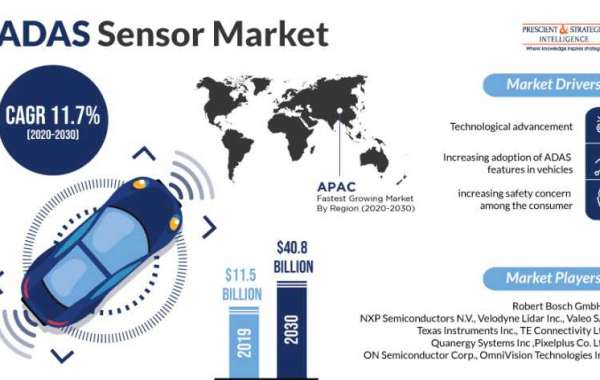
This is, in turn, propelling the expansion of the global advanced driver assistance system (ADAS) sensor market. As a result, the market valuation will surge from $11.5 billion in 2019 to $40.8 billion by 2030. Furthermore, the market will progress at a CAGR of 11.7% between 2020 and 2030, as per the estimates of the market research firm, PS Intelligence. Between semi-autonomous and fully-autonomous vehicles, the requirement for ADAS sensors will rise sharply in the latter in the future years.
This will be because of the introduction of level 5 and level 4 autonomous vehicles in several countries. ADAS sensors are heavily used in both commercial vehicles and passenger cars. Between these two, the requirement for ADAS sensors was found to be higher in passenger cars during the last few years and this trend is predicted to continue in the coming years as well. This will be because of the soaring manufacturing and sales of passenger cars around the world.
Across the globe, the demand for advanced driver assistance system sensors was observed to be the highest in Europe in the years gone by. On the other hand, in the forthcoming years, the sales of these sensors will soar in the Asia-Pacific (APAC) region, as per various reports and estimates. This will be a result of the surging manufacturing of automobiles and the rapid technological advancements and innovations being made in the automotive industry in the region.
Hence, it can be said with full surety that the demand for ADAS sensors will shoot up all over the world in the coming years, mainly because of the growing incidence of road accidents and the increasing enactment of strict government measures and policies regarding vehicular safety in various countries.